
8 min read · Distributor guide
Rechargeable vs Replaceable-Battery OTC Hearing Aids: The Stocking Decision
Our catalog has already voted — 52 of 64 models are rechargeable. But the twelve battery-door models survive for hard commercial reasons, and the right stocking mix depends on which market you are actually buying for.
By Daerdo OEM Team · August 11, 2026
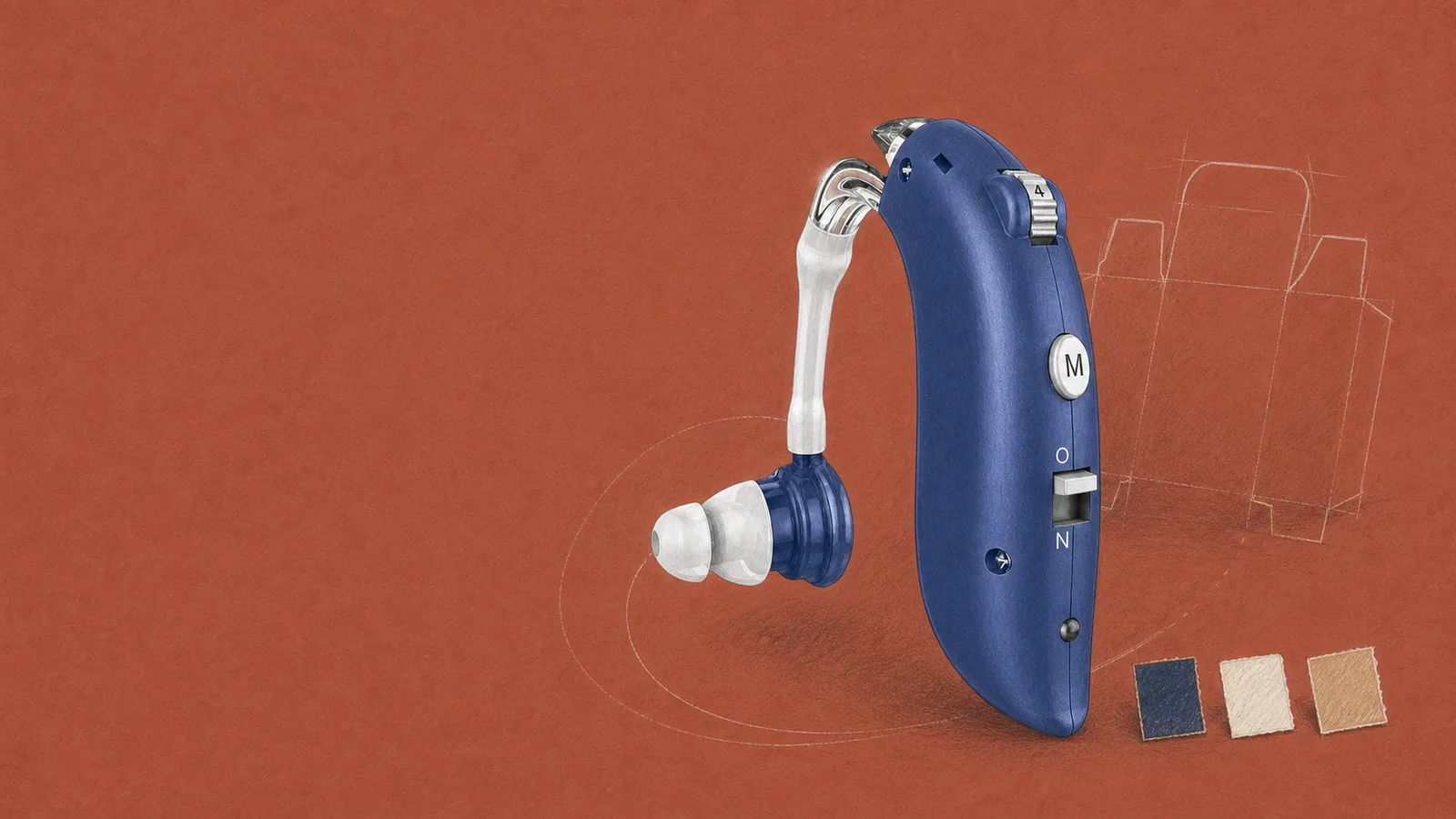
In our own catalog of 64 OTC hearing aid models, 52 are rechargeable — 81%. Read quickly, that looks like a settled argument. But the twelve battery-door models are still in the line for a reason: in several markets and price bands they remain the rational purchase, and a distributor who stocks 100% of either format is usually subsidising a mismatch somewhere. Like the warranty model, this is a decision made at purchase-order time, not at the returns desk.
This guide puts the two formats side by side the way a buyer should see them: what each costs the end user over time, which users each one actually suits, what each does to your service load, and how to split a stocking mix by market instead of by fashion.
What each format costs the end user over time
The sticker comparison understates the difference. Zinc-air button cells are a recurring cost with a short rhythm: a size 10 cell lasts about 3–7 days, a size 312 about 3–10 days, a size 13 about 6–14 days — and heavy Bluetooth streaming pushes each toward the bottom of its range. Packs of 18 cells retail around $10–17, which works out to roughly $30–150 per year depending on device style and wear time. A rechargeable model replaces all of that with a nightly habit and a charging case.
| Battery-door (zinc-air) | Rechargeable (sealed lithium) | |
|---|---|---|
| Wholesale price, our catalog | $3.5–16 per unit (median $8.4) | $4–41.4 per unit (median $13) |
| Consumable cost to end user | ≈$30–150 per year in cells | None — electricity only |
| User routine | Swap cells every 3–14 days | Dock in the case nightly |
| What ages | Nothing in the device; cells are fresh each swap | The built-in cell — capacity fades on a fixed curve |
| End of life | Device fails for other reasons | Battery fade can retire an otherwise working device |
That last row is the asymmetry buyers miss. In a battery-door device the power source is renewed every week, so the electronics set the lifespan. In a sealed rechargeable, the cell is the component that ages — lithium capacity fades measurably within the first year of nightly charging — and it is not user-replaceable. The full arithmetic of cycle ratings and runtime fade is covered in the rechargeable battery life guide; the short version is that a rechargeable hearing aid carries a designed lifespan the way a battery-door model does not.
Why rechargeable took 81% of the catalog anyway
Share of the 64 models in our current catalog that ship with a sealed rechargeable cell rather than a zinc-air battery door.
Source: Daerdo model catalog, August 2026
The catalog did not drift there on styling. Three forces pushed it. First, dexterity: the core OTC demographic is older adults, and a size 10 or 312 cell is a small, slippery disc with a pull-tab — a weekly fine-motor task imposed on exactly the users least equipped for it. Dropping the aid into a case at night asks nothing of fingers or eyesight. Second, feature current draw: Bluetooth streaming cuts runtime by 30–50%, and sustained streaming sits more comfortably on a lithium cell than on a zinc-air chemistry that was engineered for steady low-power amplification. Almost every app-connected or streaming model is rechargeable for that reason. Third, retail expectation: in US and EU mainstream retail, a charging case now reads as the default — a battery door reads as the budget tier.
Note what that list is: user demographics, feature set, and shelf perception. None of it is battery engineering. The zinc-air cell itself remains an excellent power source — which is exactly why the format refuses to die at the price floor.
Where battery-door models still win
- The price floor. In our catalog the battery-door median is $8.4 against $13 for rechargeable, and the entry point is $3.5. When the target retail price is fixed by the market, that gap is the difference between hitting the shelf price with margin and missing it.
- Markets where charging is the weak link. Where household power is intermittent or users travel for days without outlets, a strip of cells in a pocket beats any charging case. Format choice here is infrastructure-driven, not preference-driven.
- Service simplicity. A battery-door device has a first diagnostic step the user performs alone: fit a fresh cell. A sealed device that will not wake up is an immediate service contact and, as the warranty guide lays out, at low unit prices every avoided claim matters more than the clause language.
- Inventory behaviour. Zinc-air cells keep for years in their sealed tabs, and a warehoused battery-door device is not aging in the way that matters. A sealed lithium device is quietly spending calendar life in the carton — slow-moving rechargeable stock is a cost that never appears on the PO.
- No charging accessory to buy, pack, certify or replace. The case is a second electronic product inside the box: it adds BOM cost, its own failure modes, and its own warranty claims.
The stocking mix, by market profile
| Market profile | Rational anchor | Why |
|---|---|---|
| US / EU mainstream retail & online | Rechargeable, Bluetooth-capable | Buyer expectation is set by consumer electronics; the case is part of the perceived value |
| Price-led marketplaces | Battery-door entry SKUs + one rechargeable step-up | The floor price wins the listing; the step-up captures upgrades |
| Regions with unreliable grid power | Battery-door majority | Charging is the failure point; cells are the infrastructure |
| Pharmacy / senior-focused channels | Rechargeable | Dexterity is the deciding factor for the core user |
| Institutional / donation programs | Battery-door | Lowest unit cost, no charger logistics, field-serviceable by cell swap |
The pattern across our own order book matches the table: mixed portfolios with a rechargeable anchor and a battery-door hedge outperform single-format bets. The 81/19 split in the catalog is not a recommendation to stock 81/19 — it reflects demand aggregated across very different markets, and your mix should follow yours.
What to ask the factory before committing
- For rechargeable models: the cycle rating and its end-of-life threshold, in writing. 500 cycles to 80% capacity and 500 cycles to 70% are different products at the same headline number — and ask for the charging case cell specification too, because the case ages on the same chemistry.
- For battery-door models: the cell size, and whether it is a standard one. Sizes 10, 312, 13 and 675 are available in any pharmacy worldwide; a non-standard cell strands your end users the day your stock runs out.
- Door mechanics. The hinge and contacts are the moving parts that see a cycle every few days. Ask how the door is rated and what the replacement part policy is — a broken door on a working device is an avoidable return.
- Ingress protection as tested, per format. A battery door is an opening in the enclosure; a sealed rechargeable body can be gasketed. Ask for the IP rating of the actual configuration you are buying, not the platform brochure figure.
- Regional charging compliance for the case. The case is the item that plugs into the wall: confirm its certification set (and cable standard) for your destination market separately from the hearing aid itself.
Bottom line
- End-user economics differ in shape, not just size: zinc-air costs $30–150 a year forever; rechargeable costs nothing monthly but puts the device itself on an aging clock.
- Rechargeable won 81% of our catalog on dexterity, streaming current draw and retail expectation — not on battery chemistry.
- Battery-door still wins at the price floor ($3.5 vs $4+ entry, $8.4 vs $13 median in our catalog), off the reliable grid, and wherever service simplicity is worth more than shelf polish.
- Stock a mix that matches the market profile, anchor it with the format your channel expects, and put the cycle rating or the cell size — whichever applies — in the contract.
Source with Daerdo
Test fit and feedback on a real device — sample from a single unit.
OTC hearing-device platforms for distributors and private-label brands, built at an FDA-registered facility. Verify the return-reducers in this guide on an actual sample before you commit volume.
Sources
- California Hearing — How long do hearing aid batteries last? (size 10 vs 312 vs 13 vs 675)
- Audiology & Hearing Health — Hearing aid battery pack pricing and annual cost
- Hearing Review — Expert Insight: battery life per charge and how Bluetooth affects it
- Performance degradation and failure characterization of Li-ion batteries in hearing aids: insights from field data — Journal of Power Sources
- FDA — Establishing Over-the-Counter Hearing Aids (Final Rule, Federal Register 2022-17230)