
Separate discovery, connection and the intended task
Discovery means a device appears as available in the phone settings. Connection means the phone reports a connection. Neither observation, by itself, confirms the result of a call, a media session, a reconnection after charging, or another task you have not tested.
The demonstration can support a statement about what happened in that filmed setup. It cannot establish every iPhone or Android combination, every software version, an app feature, television compatibility, sound quality or clinical benefit. A visible device name also does not establish a particular Bluetooth hearing-aid protocol.
For protocol terminology and the questions to ask about it, use our Bluetooth connectivity sourcing guide. Keep that documentation review separate from the observations in the sample test.
Start with one specific test environment
Before requesting the sample, write down the phone model and exact operating-system version. Then name the task you expect to evaluate. “Bluetooth support” is too broad to be an acceptance condition; “complete a named task on this phone” gives both sides something observable to discuss.
Your brief can include:
- The exact phone model and operating-system version.
- The task to evaluate, such as a call or media session, without assuming the sample supports it.
- The proposed device configuration and the instructions supplied for that sample.
- Any accessory involved in the test.
- The destination market and the documents your buying decision requires.
Do not fill missing software versions or sample details from the demonstration. If a detail is unknown, keep it visible as unknown and request confirmation before treating it as a commitment.
Record what happened, including failures
A useful sample record identifies the sample, test date, phone, software version, instructions followed and observed outcome. Keep discovery, connection and the intended task as separate entries so a connection indicator is not accidentally reported as successful task performance.
For each agreed test, note what you actually saw. If the device did not appear, did not connect, disconnected, or did not complete the intended task, record that result. A repeat after changing the phone or configuration is a new test, not a correction that erases the first outcome.
If reconnection matters to your intended use, agree on that check as a separate step. Keep the result tied to the tested sample and environment. Expanding the phone list, operating-system versions or tasks requires additional evidence; one successful combination does not automatically cover the others.
Keep market documentation as a separate buyer gate
A pairing demonstration is not evidence of approval or eligibility in a destination market. Ask for the current model-specific documents and review them for the role you will hold as buyer, distributor or importer. Do not substitute a Bluetooth connection screen for that review.
Likewise, a sample test does not settle the commercial configuration, production consistency, warranty process or order terms. Confirm those separately in the written quotation and order record. This makes unresolved items visible rather than compressing them into a general “compatible” claim.
Send a sample enquiry that can be answered
For a G25BT Bluetooth BTE sample, send the exact phone and OS, intended task and destination market. Include any current buying requirement you already have, and identify what still needs to be confirmed.
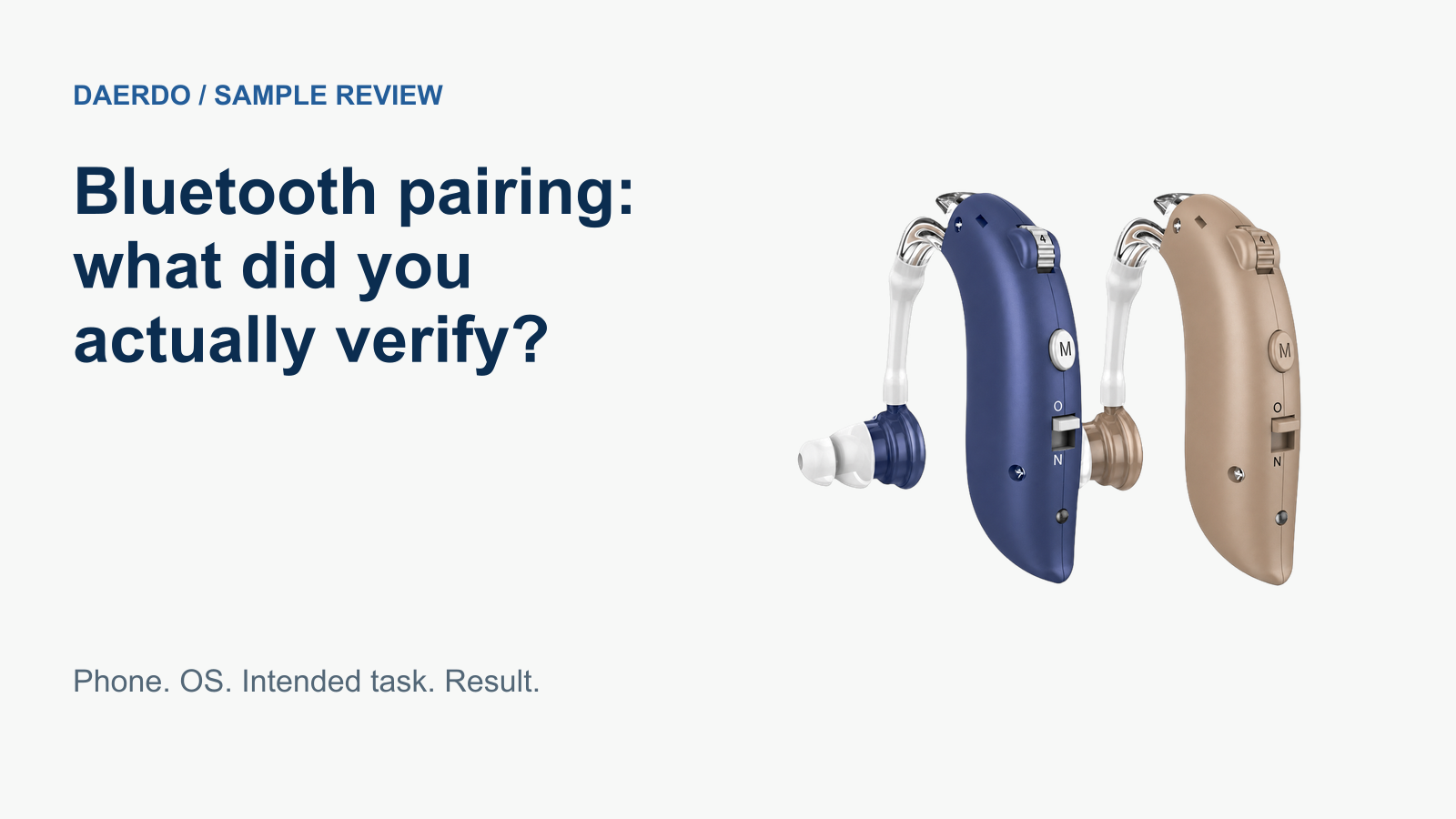
G25BT is presented in the current product record as a rechargeable behind-the-ear device with Bluetooth connectivity, a volume wheel, an M button and an O/N switch. The filmed pairing sequence is additional observation, not a replacement for the instructions and compatibility details supplied with your proposed sample.
DAERDO is the hearing-device brand and export company. Start with the product enquiry and keep the reply, sample test and commercial confirmation linked to the same model and configuration. That produces a buyer record you can use — not just a video you can share.