
10 min read · Distributor guide
Bluetooth in OTC Hearing Aids: Classic, MFi, ASHA and LE Audio — What to Source
Four different Bluetooth approaches ship in hearing aids today, and the one your platform uses decides which customers can stream, how long the battery lasts, and how many support tickets you inherit. This guide explains what actually separates them and what to ask a factory before you commit.
By Daerdo OEM Team · August 1, 2026
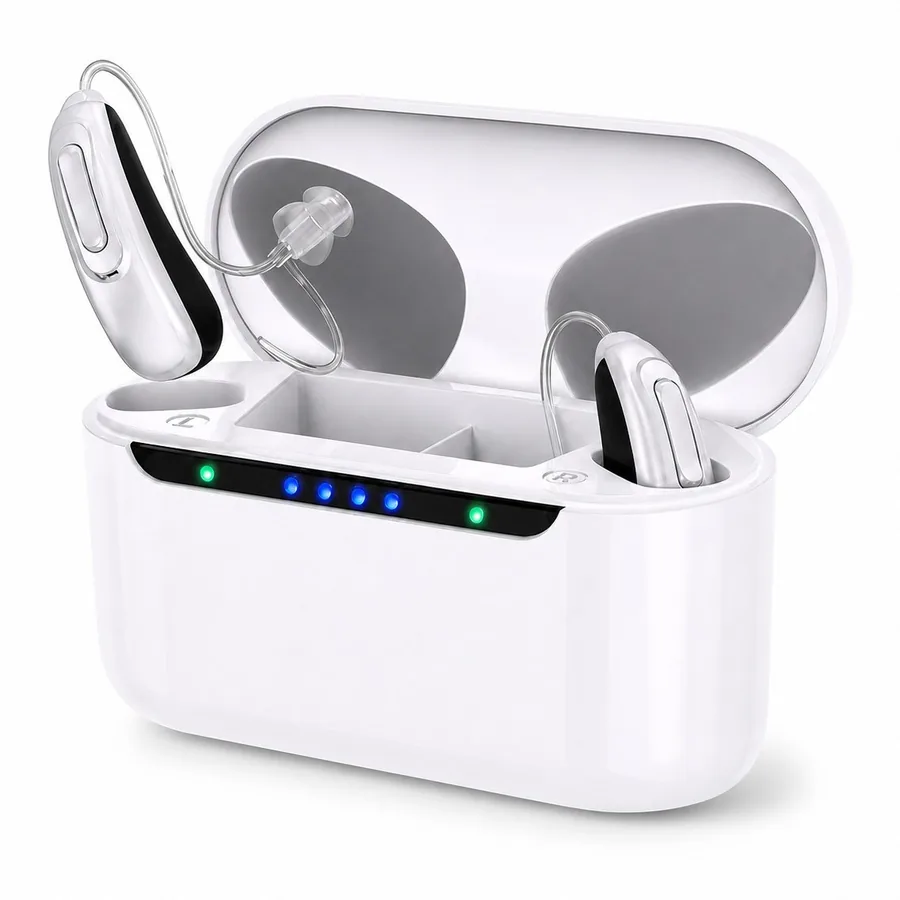
"Bluetooth" on a hearing aid datasheet is not one feature. There are four different approaches in the market, they behave differently on different phones, and the one baked into your platform decides three commercial things: which customers can actually stream, how much battery you spend doing it, and how many support tickets you inherit.
This is the connectivity question a distributor or private-label brand has to settle at the sourcing stage, because it is fixed in the chip — you cannot change it later with a firmware note. Below: what genuinely separates the four, where compatibility breaks in practice, and what to put to a factory before you order.
The four approaches
| Approach | How it works | Works with | Cost to you |
|---|---|---|---|
| Bluetooth Classic (A2DP/HFP) | Standard Bluetooth audio, same as a headset | Almost any phone, regardless of OS version | Highest power draw — shortest streaming battery life |
| MFi (Made for iPhone) | Apple’s own low-energy protocol for hearing devices | iPhone and iPad only | Requires Apple’s programme; no Android support |
| ASHA (Audio Streaming for Hearing Aids) | Google’s low-energy streaming for Android | Android 10+ and a compatible chipset | Fragmented in practice — see below |
| Bluetooth LE Audio (with Hearing Access Profile) | The new Bluetooth standard, LC3 codec, Auracast-capable | Phones with Bluetooth 5.3 and LE Audio support | Best efficiency, smallest installed base today |
The short version: Classic buys you reach at the cost of battery. MFi and ASHA buy you efficiency at the cost of covering only one platform each. LE Audio is where the standard is going, but the phones have to catch up.
Where compatibility actually breaks
The datasheet will say "Bluetooth compatible." What your customers experience is more specific than that, and the gap is where returns come from.
- ASHA is not simply "Android 10 and up." It also needs a compatible chipset, which is why support varies by phone model rather than by OS version. Pixel and flagship Samsung handsets generally work well; budget and older devices often do not, even on a recent Android version.
- MFi covers Apple only. A platform that streams beautifully to an iPhone streams to nothing on Android unless it also carries Classic or ASHA.
- Classic is the compatibility fallback. It works across a far wider range of Android phones without caring about version — which is precisely why some manufacturers still use it despite the power cost.
- LE Audio needs the phone to support it too. Bluetooth 5.3 hardware plus OS support; the installed base is growing but is still a minority of phones in the field.
The commercial translation: if your market is price-sensitive and mixed-device — emerging markets, older buyers, whatever handset they already own — a platform that only does ASHA will generate "it doesn’t connect" complaints from a real share of your customers, and those complaints turn into returns.
The battery trade nobody puts on the datasheet
Streaming is the single heaviest thing a hearing aid does. Classic Bluetooth was designed for headsets with far bigger cells, so a hearing aid running Classic burns through runtime noticeably faster while streaming than one on a low-energy protocol.
That matters commercially because "battery doesn’t last a day" is a returns driver, and a buyer who streams podcasts for three hours will hit it long before a buyer who only takes calls. When you compare quoted runtime figures between platforms, ask whether the number is standalone or streaming — they are very different numbers, and vendors do not always say which one they are quoting.
It also interacts with form factor: the smallest canal devices have no room for a battery big enough to feed a radio, which is why streaming and invisibility rarely come together (covered in our form factor guide).
LE Audio: what it changes, and when to move
LE Audio is the genuine generational change. Its LC3 codec delivers better audio at lower bitrates, which means better sound and longer battery at the same time — the first time those two have moved in the same direction. It also brings Auracast, public audio broadcast that a hearing aid can tune into directly (think airport announcements, a lecture hall, a TV in a waiting room).
The honest constraint is the other end of the link. LE Audio needs a phone with Bluetooth 5.3 and OS support, and while that installed base is growing quickly, most people in most markets are not carrying one yet. A platform that is LE Audio only will not stream for a large share of buyers today.
A practical sourcing position for the next couple of years: prefer platforms that carry LE Audio plus a fallback (Classic or ASHA), rather than LE Audio alone. You get the efficiency where the phone supports it and you do not strand the customers whose phones do not.
The support burden you are buying
Connectivity generates a specific and predictable class of complaint, and it is worth knowing what it looks like before it lands in your inbox rather than after:
- "It won’t connect to my phone." Usually an ASHA chipset mismatch, or a phone too old for the protocol the device uses.
- "It hijacks all my audio." Under ASHA and LE Audio, Android registers hearing aids as an accessibility device and deliberately gives them top priority for media routing — so they reconnect aggressively and grab audio back from speakers. This is by design, not a fault, but users read it as a bug.
- "It broke after a phone update." Android 16/17 reworked the audio routing stack, so a wave of recent reports are phone-side rather than device-side. Your product did not change; the phone did.
- "Calls work but music doesn’t" (or the reverse). Different profiles handle each, and a platform may implement one well and the other poorly.
None of this is fixable by your support team. It is decided by which protocol and chipset the platform ships with — which is exactly why it belongs in the sourcing conversation.
Matching connectivity to your market
| Your market | Sensible choice | Why |
|---|---|---|
| Mixed handsets, price-sensitive, emerging markets | Classic, or Classic + LE Audio | Widest reach; accept the battery cost rather than the "won’t connect" complaints |
| US/EU retail with mostly recent phones | LE Audio with a fallback | Efficiency and Auracast where supported, no stranded buyers where not |
| iPhone-heavy premium positioning | MFi (plus ASHA or Classic if you also sell Android) | Best-integrated Apple experience |
| Entry-level, no streaming promised | No Bluetooth at all | Do not pay for a radio your buyer will never use — and do not advertise one |
That last row is worth stating plainly: not every SKU needs Bluetooth. A value BTE bought for conversation and TV, sold to a buyer who does not stream, is cheaper and lasts longer without a radio. Adding connectivity to a product whose customer will not use it raises your cost and your battery complaints at the same time.
What to ask the factory before you order
- Which protocols does this platform support — Classic, MFi, ASHA, LE Audio — and which chipset provides them?
- If LE Audio: is there a fallback protocol for phones that do not support it?
- Is the quoted battery runtime standalone or streaming? Ask for both figures.
- If ASHA: which phone models has it actually been tested against? Ask for the test list, not a claim of "Android compatible".
- Is there a companion app, who maintains it, and how long will it be updated for?
- Has the platform been tested on the current Android and iOS releases — and what happens at the next OS update?
A supplier that answers "which chipset" and "tested on which models" in writing is telling you they know their own product. Vague "Bluetooth 5.0 compatible" answers are how you end up owning a connectivity problem you did not price in.
Where sourcing fits in
Protocol, chipset, fallback behaviour and streaming battery life are all fixed before the device is boxed. You cannot market your way out of a platform that will not connect to half your customers’ phones — which is the practical reason connectivity is a sourcing decision rather than a spec-sheet bullet.
Daerdo builds OTC hearing-device platforms — including Bluetooth BTE and app-controlled RIC — for distributors and private-label brands at an FDA-registered facility (Establishment Registration No. 3013596029 — a registration, not an FDA approval or endorsement). Order a sample from a single unit, pair it with the phones your market actually carries, then scale what holds up.
Source with Daerdo
Test fit and feedback on a real device — sample from a single unit.
OTC hearing-device platforms for distributors and private-label brands, built at an FDA-registered facility. Verify the return-reducers in this guide on an actual sample before you commit volume.