
Start with the model, not the category
Keep the comparison specific. Use the exact model identifier and configuration rather than transferring a specification from another device with a similar name.
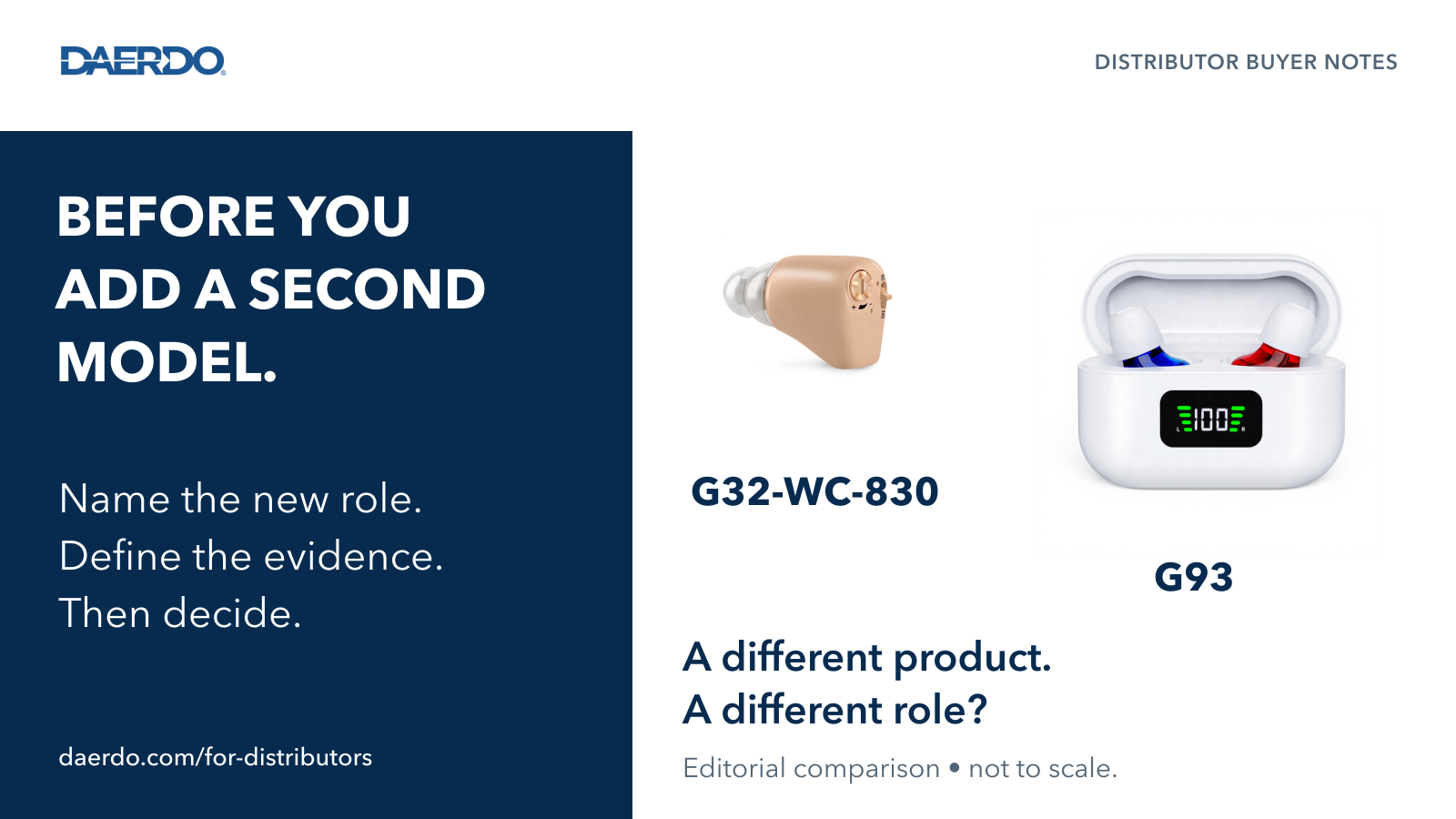
G32-WC-830: the current DAERDO product page presents a compact rechargeable in-ear model with a visible volume wheel and separate ON/OFF switch.
G93: the current product page presents two rechargeable CIC hearing devices that dock in one charging case; its manufacturer-listed controls include a volume knob and four listening modes.
G25BT: the current product page presents a rechargeable Bluetooth BTE hearing aid, with a visible volume wheel, M button and O / N switch.
Treat these as selected comparison points, not a complete specification or a ranking.
Decision 1: G32-WC-830 first—what would G93 add?
Imagine you have shortlisted G32-WC-830 to demonstrate a compact in-ear product with physical controls. Do not make “another in-ear model” the whole argument for a second SKU.
G93 offers a concrete comparison point: two hearing devices dock in the same charging case, and four listening modes are listed in its factory product sheet.
Our suggested add condition: consider G93 when that paired case arrangement or the mode selection answers a separate requirement in your channel brief. Build the demonstration around the exact handling task you want to evaluate.
Our suggested hold condition: if the only distinction you can explain is a different shell, keep G93 on the comparison list rather than automatically adding it to the order.
Evaluate each complete offered configuration on its own merits. Do not treat a feature highlighted on one product page as proof that another model lacks it.
Decision 2: An in-ear model first—when consider G25BT?
Use this scenario when your proposed range needs a specifically defined behind-the-ear Bluetooth option, rather than another in-ear choice.
G25BT is presented as a rechargeable Bluetooth BTE model; its visible controls include a volume wheel and an M button.
Our suggested add condition: consider it when that form and connectivity proposition has a named role in your range, and you are prepared to evaluate it against the exact devices used in your sales demonstration.
For that evaluation, name the phone or other source device, the intended task, the supported connection route and the pass condition. Then check the current instructions and the actual sample against that test.
Our suggested hold condition: do not write a compatibility promise, commit to a streaming demonstration or order for that purpose before the exact configuration has passed your intended-use check.
Decision 3: Neither model earns a separate role yet
Pause the addition. Write a short internal decision note instead of adding another product merely to make the range look larger.
Use this three-line record:
- New role: the specific proposition you want to add, expressed without words such as “better” or “premium” unless you can define and support them.
- Evidence to evaluate: the exact model information, sample task and offered configuration relevant to that role.
- Reopen condition: the result or newly confirmed fact that would change the hold decision.
For example, a proposed Bluetooth BTE addition could remain on hold until the intended demonstration has been checked on the named source device. That is an illustrative decision record, not a claim about a completed DAERDO test.
Define the addition before the order
Use one sentence to finish the exercise: “We are considering this model because it adds ___ to our current range, and we will evaluate that using ___.”
If you cannot fill in both blanks specifically, keep comparing before committing to a broader range.
When discussing a range with DAERDO, include your destination market, sales channel, current model or shortlist, and the distinct role you want the next model to fill. Keep the written commercial offer and the intended-market documentation separate from this editorial comparison.