
9 min read · Distributor guide
OTC Hearing Aid Form Factors: BTE, RIC, CIC & ITE — A Sourcing Guide
Behind-the-ear, receiver-in-canal, in-the-ear, completely-in-canal — the shell you source decides your price floor, battery life, feature ceiling and who buys it. This guide breaks down what each form factor really trades off, what the market actually buys, and how a distributor or private-label brand should choose which shapes to stock.
By Daerdo OEM Team · July 27, 2026
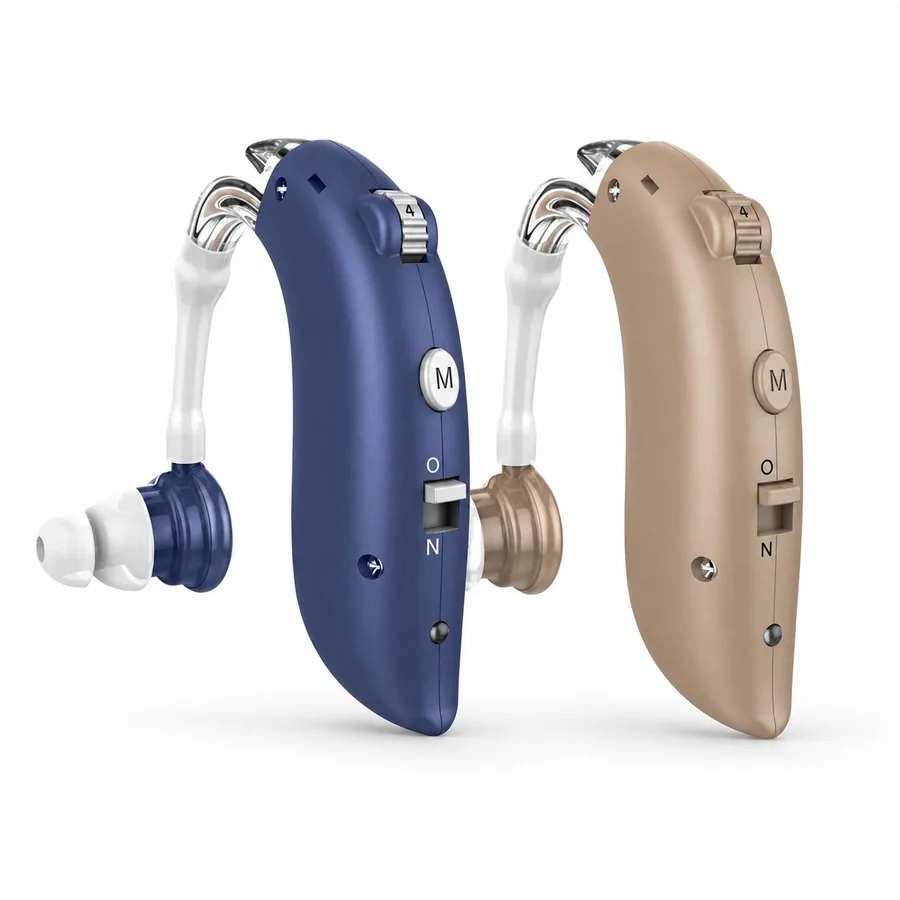
Ask a first-time buyer to picture a hearing aid and they’ll usually describe one shape. But the device comes in four main form factors, and for a distributor or private-label brand the choice is not cosmetic — the shell decides the battery life, the feature ceiling, the range of hearing loss it can serve, the price floor, and which customer reaches for it. Get the form factor wrong for your market and you inherit returns you could have designed out at the sourcing stage.
This guide walks through the four shapes — BTE, RIC, ITE/ITC and CIC/IIC — what each genuinely trades off, what the market actually buys today, and a practical way to decide which shapes to stock. Where a number is cited, it links to a source you can check.
The four form factors at a glance
All four sit on a single spectrum: the more of the device you hide inside the ear canal, the more discretion you gain and the more battery, features and connectivity you give up. There is no "best" shape — only the right trade for a given buyer.
| Form factor | Where it sits | Visibility | Typical trade |
|---|---|---|---|
| BTE — behind-the-ear | Body behind the ear, tube into the canal | Most visible | Biggest battery, most power and features, easiest to handle |
| RIC — receiver-in-canal | Small body behind ear, receiver in the canal | Discreet | Best all-round balance — the market default |
| ITE / ITC — in-the-ear / in-canal | Custom shell filling part of the ear | Low | Fits the bowl of the ear; easier to insert than CIC |
| CIC / IIC — completely / invisible-in-canal | Deep in the canal | Nearly invisible | Maximum discretion, smallest battery, least connectivity |
Scroll horizontally to view the full diagram.
BTE: the workhorse
The behind-the-ear shape puts the electronics and battery in a housing that sits behind the ear, with sound carried through a thin tube or wire to the canal. Because the body sits outside the ear, it has the most room — so BTE platforms carry the largest batteries, the most amplification headroom, and the easiest handling (a real advantage for older users or anyone with dexterity issues).
- Strengths — longest battery life, most power (serves a wider loss range), easy to insert and remove, simple to clean, and room for rechargeable cells and Bluetooth.
- Trade-offs — the most visible shape; some buyers still read it as "old-fashioned," though modern slim BTE and RIC designs have largely closed that gap.
- Best for — value and first-time buyers, older users, and any market where battery life and easy handling matter more than invisibility.
RIC: the market default
Receiver-in-canal took the classic BTE and moved just the receiver (the speaker) out of the body and into the canal on a thin wire. That shrinks the behind-ear housing dramatically while improving sound, because the speaker now sits closer to the eardrum. The result is the shape most of the market now fits.
Share of the U.S. OTC hearing-aid market held by the receiver-in-canal (RIC) form factor in 2024 — the single largest product segment
Source: Global Market Insights — U.S. OTC Hearing Aids Market (2024)
Behind-the-ear-style shapes (BTE and RIC together) dominate globally, with BTE alone reported at roughly a third of the world market in 2024. The practical takeaway for sourcing: a discreet RIC plus a value BTE covers the large majority of what buyers ask for before you ever touch custom in-ear shells.
ITE / ITC: the custom middle
In-the-ear and in-the-canal aids are custom-molded shells that fill the bowl of the ear or the outer canal. They’re less visible than a BTE and easier to insert than the tiniest canal aids, and the larger ITE can still fit a usable battery and some connectivity. The catch is that they’re custom units — each one is built to an individual ear impression, which changes your production and fulfilment model versus a standard-fit BTE or RIC.
CIC / IIC: maximum discretion, real physics limits
Completely-in-canal and invisible-in-canal aids sit deep in the ear canal and are the closest thing to "invisible." That discretion is exactly why buyers ask for them — and exactly why they carry the hardest trade-offs, which are physics, not marketing:
- Battery — a canal-sized shell holds only a tiny cell, so runtime is short and rechargeable options are limited.
- Connectivity — Bluetooth needs a chip and an antenna, and getting a radio to transmit from deep inside a canal — surrounded by tissue that blocks the signal — is genuinely hard. That’s why the smallest aids often skip streaming.
- Handling and wax — small devices are harder to insert and remove, and sitting deep in the canal means more exposure to earwax; a clogged wax filter is the usual reason a canal aid suddenly goes quiet, not a broken device.
A sourcing reality worth stating plainly: the smaller the shell, the more the buyer trades away — battery, streaming and easy handling. For most first-time OTC buyers, a well-fitted RIC delivers more day-to-day satisfaction than a CIC they can barely handle or keep clear of wax. Stock the invisible shapes for the buyers who specifically want them, not as your default.
How the shape maps to your market and margin
From a sourcing desk, form factor is a decision about who you sell to and how you fulfil. Here’s the mapping.
| Your buyer / market | Lead with | Why |
|---|---|---|
| Value and first-time OTC (emerging markets) | BTE | Longest battery, easy handling, lowest price floor, standard fit — no ear impressions |
| Mainstream OTC that wants discreet | RIC | The market default; discreet, good sound, room for rechargeable and Bluetooth |
| Premium / "invisible" positioning | CIC / IIC | Sells on discretion; accept shorter battery and limited streaming |
| Custom-fit propositions | ITE / ITC | Only if you can handle ear-impression-based production and fulfilment |
For most distributors and private-label brands entering OTC, a rechargeable RIC plus a value BTE is the pragmatic starting lineup — standard-fit (no impressions), covering the bulk of demand, and keeping production and returns simple. Add canal shapes once you have a buyer who specifically wants them.
A pre-order checklist
- Does the platform ship with multiple dome sizes and styles so a standard-fit BTE/RIC actually seals across ear shapes? (Poor fit is the top return driver.)
- For any canal shape: is there a replaceable wax guard/filter, and are spares cheap and easy to source?
- If you need streaming, confirm Bluetooth on the BTE/RIC lines — don’t expect it on the smallest canal aids.
- Rechargeable or disposable-battery? Rechargeable is easiest on a BTE/RIC and hard on a CIC.
- Sample a single unit and verify fit, feedback and handling on a real device before you commit volume.
Where sourcing fits in
Daerdo builds OTC hearing-device platforms — BTE, RIC and canal shapes — for distributors and private-label brands from an FDA-registered facility (Establishment Registration No. 3013596029 — a registration, not an FDA approval or endorsement). Order a sample from a single unit, confirm the fit and handling on the shapes your market actually buys, then scale the lineup that survives that test.
Source with Daerdo
Test fit and feedback on a real device — sample from a single unit.
OTC hearing-device platforms for distributors and private-label brands, built at an FDA-registered facility. Verify the return-reducers in this guide on an actual sample before you commit volume.